
How Does ChatGPT Recommend Products? What Online Sellers Should Know
ChatGPT product recommendations are not a black-box ranking. They depend on retrievable sources, interpretable product evidence, and clear comparisons that an AI can explain to a shopper.
AI-assisted research and drafting; reviewed and approved by Bismion.
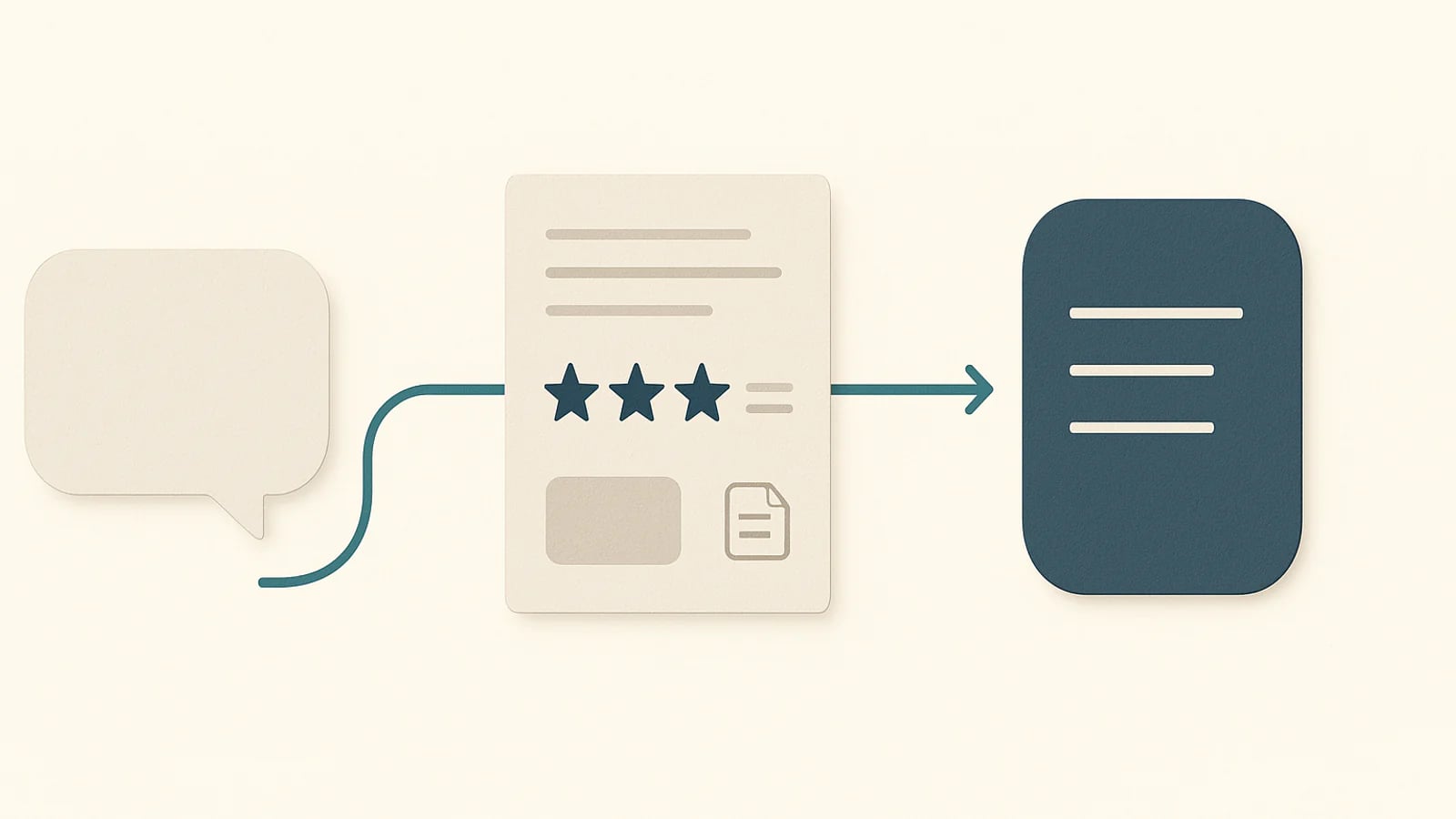
When someone asks ChatGPT for a product recommendation, the response is not pulled from a single secret score. It is composed from sources the system can retrieve, interpret, and compare. For a merchant, that means the question “how does ChatGPT recommend products?” is really a question about evidence: can the system find your product, understand its facts, and explain why it fits the request?
AI shopping recommendations vary by platform, query, and the data available at the moment. No public documentation promises a universal formula. What is documented is that product discovery depends on a combination of crawling, structured data, feeds, connected catalogs, and the text a model can read and cite.
Three stages of an AI product recommendation
A useful way to think about ChatGPT product recommendations is in three stages. First, the system needs candidates: pages, feeds, or connected catalogs that match the intent of the query. Second, it needs interpretable evidence: prices, availability, descriptions, reviews, policies, and structured data it can read and weigh. Third, it composes an answer from that evidence, often with citations or source links.
If any stage is weak, the product is less likely to be chosen. A missing page cannot be retrieved. A page with no clear product facts cannot be interpreted. A product with no reviews, return policy, or comparative details cannot be confidently recommended.
What evidence ChatGPT and similar systems can use
The exact signals are not public, but the types of evidence that matter are well understood. Merchants should make sure the following are present, accurate, and consistent across every public surface:
- Product pages with clear titles, descriptions, and current prices that match any structured data.
- JSON-LD Product schema with supported fields for price, availability, rating, and condition.
- Reachable policies: shipping, returns, and guarantees that answer common comparison questions.
- Reviews or trust signals written as text, not embedded in images or buried in PDFs.
- Consistent facts across the storefront, product feeds, and connected catalog channels.
Why consistency matters more than any single trick
A common mistake is to treat AI shopping recommendations as a ranking game where one hidden setting changes everything. In practice, the bigger risk is contradiction. If the structured data says a product is out of stock but the page says it is available, the model has less confidence. If the price in the feed differs from the price on the site, the system may not cite it.
Fixing these contradictions does not guarantee a recommendation. It removes the friction that makes an AI system skip or downrank an otherwise good candidate.
How merchants can improve their chances
Audit what is publicly visible
Use a read-only scan to check which product facts, policies, and schema fields can be retrieved from your storefront.
Fix the highest-impact gaps first
Prioritize price and availability accuracy, reachable policies, and complete Product schema before adding new content.
Verify across channels
Compare the rendered page, structured data, merchant feed, and any connected catalog to make sure they describe the same offer.
Rescan to measure change
After making changes, run another scan to see which evidence gaps were closed and whether new ones appeared.
Where to start with GEO
Generative engine optimization for ecommerce is not about tricking a model. It is about aligning public evidence with the questions shoppers ask. Start with one product category, close the most obvious gaps, and measure the change. That is the most reliable way to improve how AI chooses products over time.
Primary sources
See what AI can verify about your store
Start with a free, read-only scan. No store login and no automatic changes.